People often imagine AI bias as an obvious insult or a dramatic error. In practice, bias may be quieter. A search tool may show fewer opportunities for one group. A resume assistant may describe similar candidates differently. An image generator may repeatedly connect certain jobs, emotions, or family roles with one gender or ethnicity. A chatbot may give confident advice that works for the majority but fails people with disabilities or limited English.
AI bias is not a single technical defect. It can enter through training data, design decisions, labels, assumptions, deployment environments, and the way people interpret an output. The important question is not whether a tool is perfectly neutral. No social system is. The important question is whether the system creates unfair or harmful differences and whether people have a way to identify and correct them.
Bias begins before the model
An AI system learns from examples selected by people and organizations. If the examples underrepresent a population, contain historical discrimination, or reflect stereotypes, the model may reproduce those patterns. A system trained on past hiring decisions may learn who was previously favored rather than who is genuinely qualified.
Bias can also come from the target being measured. A school may use attendance as a signal of engagement even though transport problems or disability affect attendance. A company may use past performance ratings even though managers rated groups inconsistently. The model can be technically accurate at predicting the selected measure while the measure itself is a poor or unfair proxy.
This is why NIST treats fairness and harmful bias as part of broader AI risk management rather than as a problem solved by one test.
Where everyday users may encounter it
Search and recommendation systems can influence whose work, products, or news people see. Recruitment tools can rank or summarize applications. Education tools can recommend learning materials or estimate a student’s progress. Financial systems can assist with fraud checks or eligibility decisions. Image and language tools can reinforce stereotypes through the examples they produce.
Not every uneven result is proof of discrimination. An output may reflect a real difference in the data, a poorly worded request, or a design choice that has a legitimate explanation. But an unexplained pattern deserves questions, especially when it affects someone’s opportunity, reputation, safety, or access to services.
Look for patterns, not one strange answer
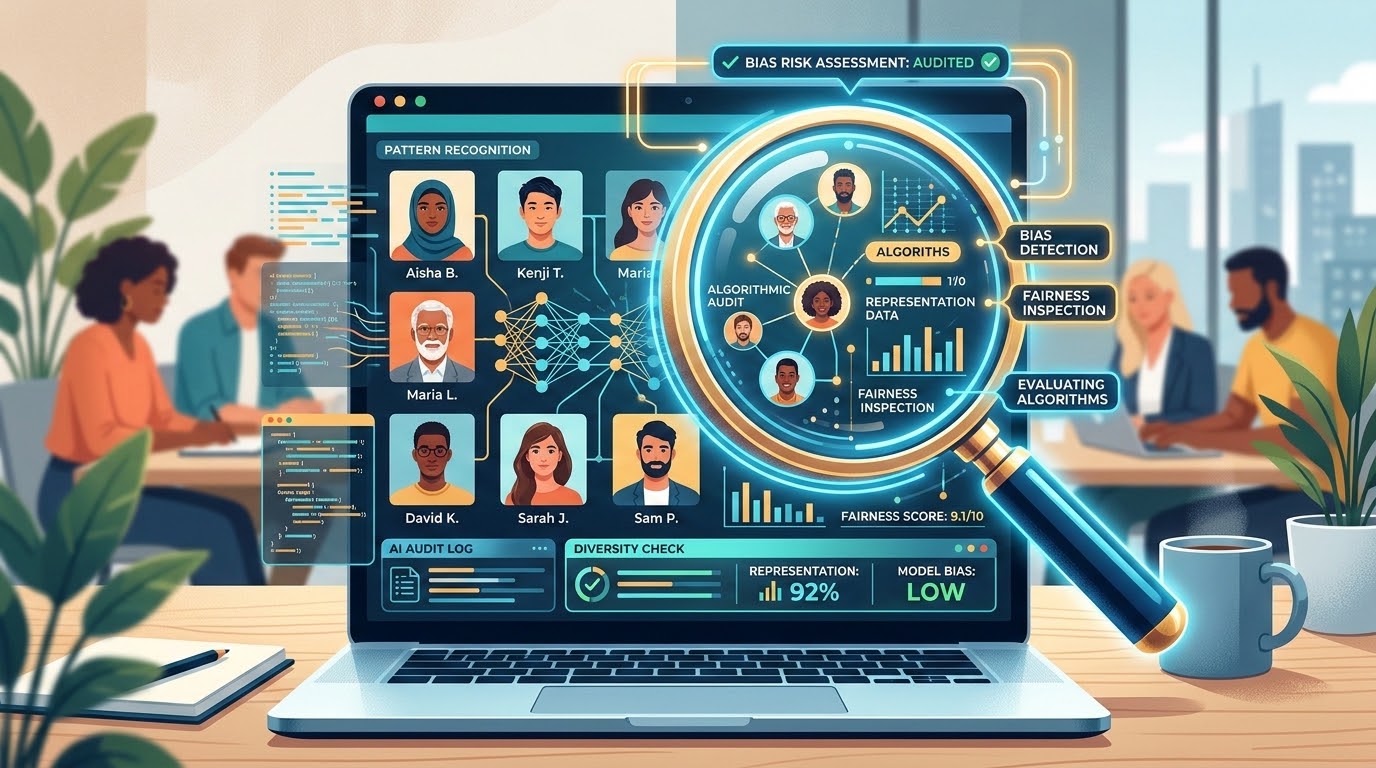
A single odd result may be a glitch. Repeat the test with comparable prompts. Change only one relevant detail while keeping the task, wording, and qualifications the same. If the output changes dramatically when a name, gender marker, accent, disability reference, or neighborhood changes, preserve the examples and investigate.
For generative tools, ask for several versions and inspect the range. If a prompt for “a successful engineer” repeatedly produces the same narrow identity, compare it with prompts that explicitly ask for varied examples. The purpose is not to force a particular answer. It is to see whether the system has a limited default representation.
For decision tools, ask who was included in testing and how error rates were measured across groups. A system can have a strong average score while performing poorly for a smaller population. Average performance hides uneven harm.
Ask what the system is using
Users should be able to ask what information influenced a recommendation or classification. A person does not need to receive a complete algorithmic formula, but they should receive a meaningful explanation of the factors that mattered and a way to challenge errors.
Watch for proxy variables. A system may not use race directly but may rely on location, school, language, purchasing history, or employment gaps that correlate with protected or sensitive characteristics. Correlation alone does not prove unfairness, but it is a reason to review the design and outcomes.
If a tool is used by an employer, school, lender, or service provider, ask whether a human can review the result. A person affected by an automated recommendation should not be trapped by an opaque score with no route for correction.
What small teams can do
Small organizations do not need a research laboratory to begin. Define the intended use and the groups that could be affected. Test realistic examples before launch. Include people with different backgrounds and abilities in review. Record known limitations and provide a clear escalation process.
Do not use a general chatbot as an unreviewed hiring or disciplinary system. Do not ask a model to infer sensitive traits from a person’s face, name, voice, or writing style. Do not convert an uncertain generated impression into a high-stakes decision.
When an error occurs, preserve the input, output, date, tool version, and human decision that followed. Look for repeated patterns rather than treating each complaint as isolated. Communicate what changed and what remains uncertain.
How to respond when you see bias
First, save evidence without spreading private information. Capture the prompt, response, relevant settings, and date. Second, test a small set of comparable examples. Third, report the issue to the provider or organization responsible. Explain the potential harm rather than only saying that the output “feels wrong.” Fourth, request human review when the result affects a real person.
If the system is used in a regulated or high-impact context, seek advice from the relevant authority or qualified professional. Rules differ by country and sector, and a blog cannot determine whether a specific use is lawful.
A fairness-minded habit
AI bias becomes easier to spot when users stop asking only, “Did the tool answer my question?” They also ask, “Who might be missing from this answer? Who could be harmed by this pattern? What evidence would change my mind? Can the affected person challenge the result?”
Those questions turn ordinary users into better reviewers. They also remind organizations that fairness is not a decorative feature added after launch. It is part of whether a system is fit for purpose.
The goal is not to demand impossible perfection from every tool. It is to make patterns visible, limit high-risk uses, invite correction, and keep human judgment responsible for consequences. AI can support people more fairly when people are willing to examine how it behaves.