Suggested slug: /using-ai-responsibly-at-work-and-school/ Primary keyword: responsible AI use Meta description: Learn how to use AI responsibly at work and school while protecting privacy, preserving your own judgment, and being transparent about AI assistance.
Artificial intelligence can help people brainstorm, summarize, translate, organize, and learn. It can make a blank page feel less intimidating and help a small team complete routine work more quickly. But a useful tool can still create problems when people use it without checking the result, protecting sensitive information, or explaining how it contributed.
Responsible AI use is not about avoiding every tool. It is about keeping people accountable for decisions and treating AI as assistance rather than an unquestionable authority. A person should remain able to explain the work, review the output, correct mistakes, and take responsibility for the final result.
Start by defining the task
Before opening a chatbot or image generator, describe the task in one sentence. Are you trying to understand a difficult concept, outline a report, improve wording, compare options, or automate a repetitive step? A clear task makes it easier to decide whether AI is appropriate.
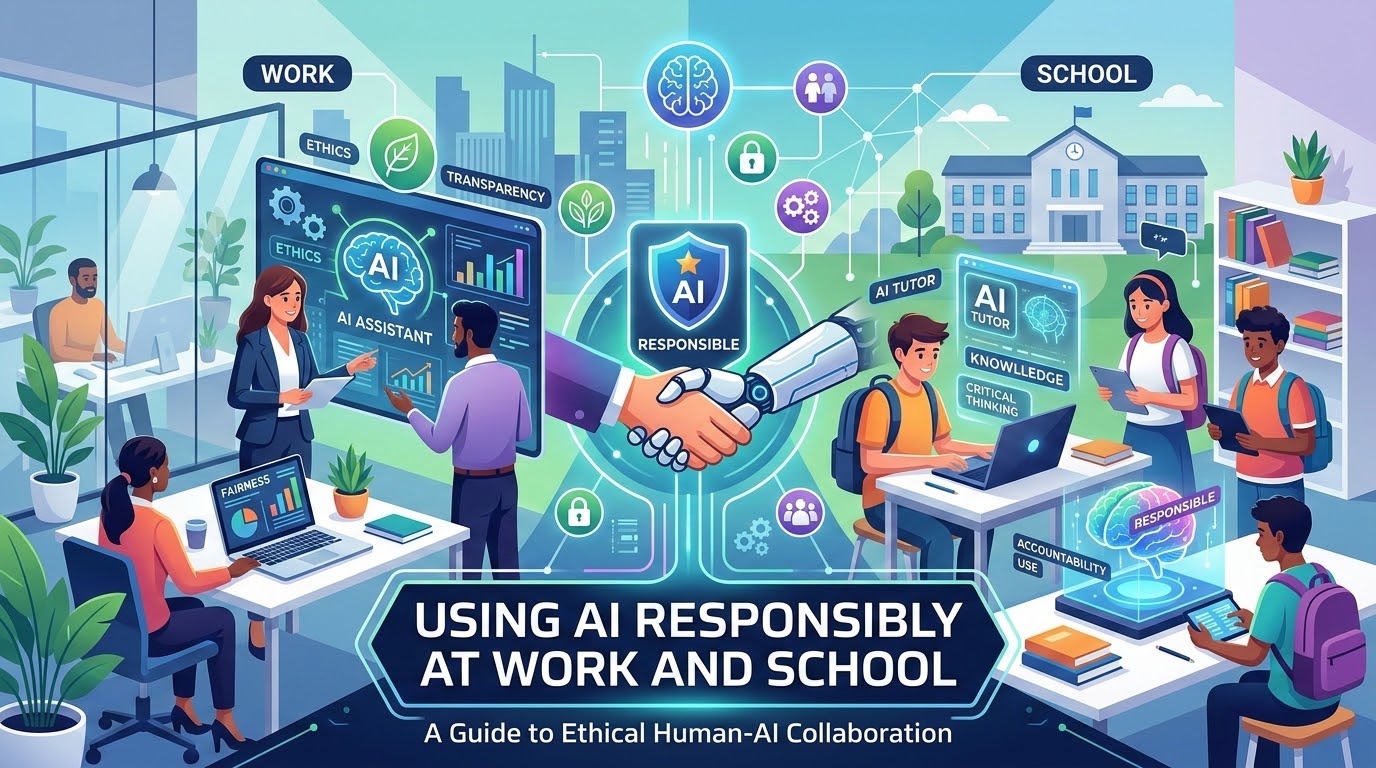
AI is often useful for low-risk preparation. A student may ask for practice questions on a topic, then solve them independently. A small business may use AI to suggest customer-service replies, then review each response before sending it. A worker may ask for a meeting agenda or a list of possible research questions.
The risk increases when the output becomes a final decision about a person. Hiring, grading, disciplinary action, access to services, and safety decisions deserve meaningful human review. A generated recommendation should never silently replace the people and procedures responsible for those outcomes.
Protect information before you prompt
Do not paste confidential information into a public AI tool unless you understand the tool’s data practices and have permission to do so. Sensitive information can include customer records, student work that contains identifying details, passwords, private messages, unpublished business plans, health information, legal documents, and internal financial data.
Remove details that are not necessary. Replace a person’s name with “employee A.” Generalize a date, location, or account number. Use a fictional example when you are asking for help with structure or tone. Data minimization is useful even when a tool promises not to use your prompts for training because the information may still be processed, retained, or exposed through an account or device.
Organizations should provide an approved-tool list and explain what employees may enter. Schools should give students clear guidance rather than leaving them to guess what is permitted. A short policy is better than silence: identify allowed uses, prohibited uses, disclosure expectations, and a person to contact with questions.
Treat output as a draft
AI systems can produce incorrect facts, invented citations, misleading summaries, and confident answers to questions they do not understand. The language may sound polished even when the underlying information is wrong. This is one reason NIST recommends managing AI risks across the system’s lifecycle rather than treating an output as automatically reliable.
Check important claims against primary or authoritative sources. If AI summarizes a policy, read the original policy. If it provides a statistic, verify the number and date. If it cites a paper, confirm that the paper exists and actually supports the statement. If the output concerns a law, school rule, health matter, or financial decision, seek the relevant official source or qualified professional.
Review the answer for missing context as well as obvious errors. A response may be technically accurate but unsuitable for the audience, culturally insensitive, inaccessible, or based on assumptions that do not fit your situation.
Preserve your own thinking
At school, the purpose of an assignment is often to develop understanding, not merely to produce a finished document. Use AI to practice, question, and improve your thinking rather than to submit work you cannot explain. A useful approach is to attempt the task first, ask AI to identify gaps, and then revise the work yourself.
At work, a similar principle applies. If AI drafts a customer message, the employee should understand the customer’s issue and confirm that the reply matches company policy. If AI creates a report, the author should know where the data came from and why the conclusion is reasonable. A manager should be able to ask, “How did you reach this result?” and receive an answer that is not simply “the tool said so.”
Be transparent about assistance
Disclosure rules vary by school, employer, and assignment. Follow the specific rule that applies to you. When no rule exists, transparency is usually safer than concealment. A short note can explain that AI was used for brainstorming, language editing, translation, or a first draft, while making clear that the final work was reviewed by a human.
Disclosure is especially important when the audience might reasonably assume that a person wrote, researched, or created the entire piece. It also matters when a generated image, voice, or video could be mistaken for a real person or event.
Transparency should not become a performance. The goal is not to add a meaningless label to every spelling suggestion. The goal is to help people understand when AI materially shaped the content or decision.
Watch for bias and unfairness
AI learns patterns from data and instructions created by people. Those patterns can reproduce stereotypes or treat groups differently. Review examples across genders, languages, cultures, disabilities, ages, and economic backgrounds when the task affects people.
A small team can test a system with equivalent prompts that change only one relevant characteristic. If a recruitment assistant recommends different language for identical candidates based on names, that deserves investigation. If an image tool repeatedly represents certain professions or families in a narrow way, do not treat the pattern as neutral reality.
The test is not perfect, but it can reveal questions that deserve human review. Never use a model’s confidence or fluent tone as evidence that its output is fair.
A simple responsible-use routine
Before using AI, ask whether the task is appropriate, whether the information is safe to share, and whether a person will review the result. During use, keep the prompt focused and avoid unnecessary personal data. Afterward, verify important claims, check for bias and missing context, and record or disclose meaningful AI assistance.
This routine protects more than an institution’s reputation. It protects the quality of learning, the dignity of customers and colleagues, and the user’s own ability to think independently.
AI can be a strong assistant without becoming the author of our judgment. Responsible use means keeping the human purpose visible at every step.