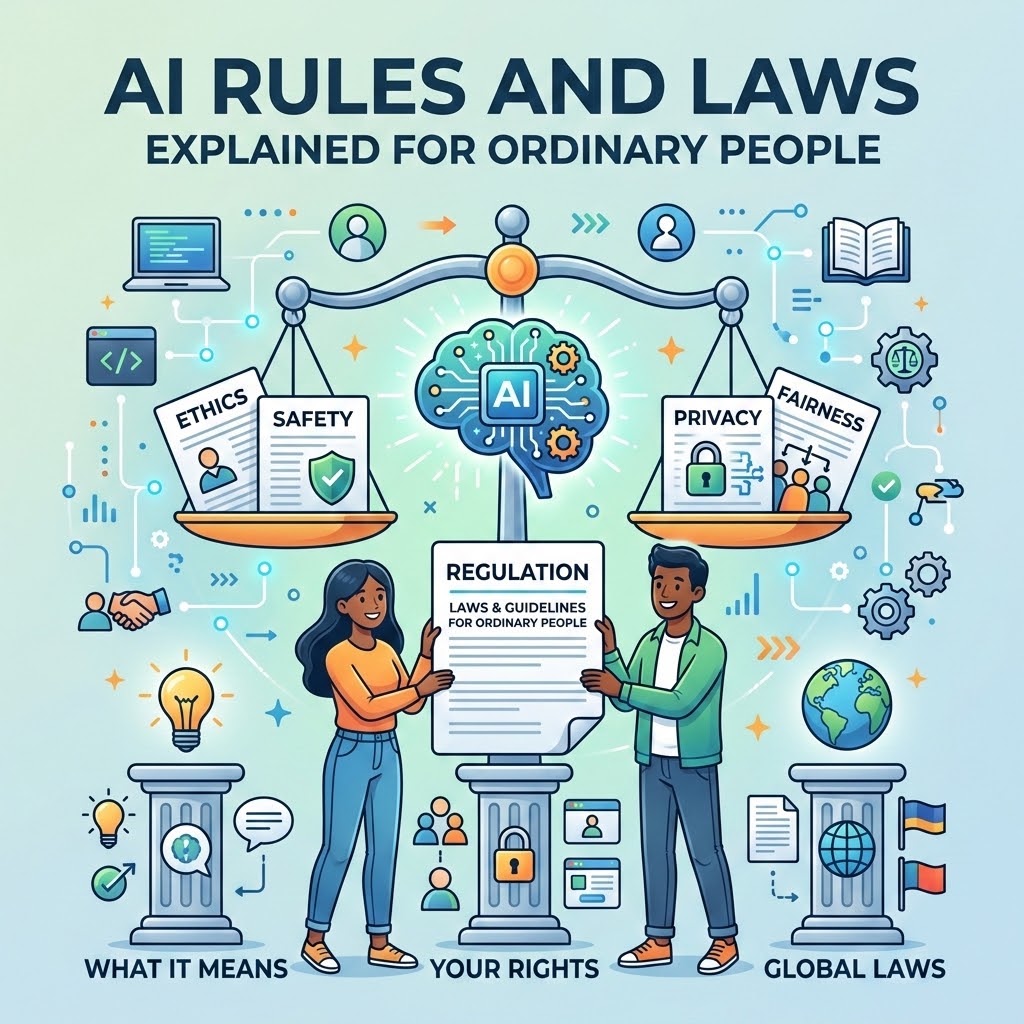
Artificial-intelligence rules are developing in different places at different speeds. Some countries regulate specific high-risk uses. Some rely on existing privacy, consumer-protection, equality, copyright, or safety laws. Others are introducing broad AI frameworks or voluntary standards. Headlines often compress these differences into a simple statement such as “AI is now regulated,” but the real answer depends on the country, sector, tool, and activity.
This article is an educational overview, not legal advice. The safest way to handle a specific situation is to check the law and official guidance in the jurisdiction where the organization operates and where affected people are located.
Why governments regulate AI
AI can influence decisions about employment, education, housing, finance, health, safety, identity, and access to information. A system may process large amounts of personal data, produce misleading content, or make it difficult for people to understand why a decision occurred.
Regulation tries to manage these risks without blocking useful innovation. Common goals include protecting privacy, preventing discrimination, requiring safety controls, supporting transparency, preserving human oversight, and giving people a route to challenge harmful outcomes. These goals overlap with principles from frameworks such as the OECD AI Principles and UNESCO’s recommendation on the ethics of AI.
The main concepts to understand
Risk-based rules treat uses differently according to potential harm. A tool that helps write a birthday invitation is not treated like a system used to evaluate a job applicant or control critical infrastructure. Higher-risk uses may require stronger testing, documentation, oversight, and monitoring.
Transparency means people should receive understandable information when AI materially affects an interaction or decision. Transparency may involve labeling synthetic content, explaining that a chatbot is automated, or telling a person that an AI-assisted process is being used.
Human oversight means people remain capable of reviewing, questioning, and overriding an AI system. A human reviewer should have enough authority, time, information, and training to do more than approve a recommendation automatically.
Accountability means someone is responsible for the system’s use. A company cannot avoid responsibility by saying that an external model produced the output. It should know what the tool does, what data it handles, and how problems are reported.
Data governance concerns the quality, purpose, security, and lawful handling of data. Organizations should collect only what they need, protect it, and avoid using it for unrelated purposes without an appropriate basis.
The European Union example
The EU AI Act uses a risk-based structure and assigns obligations according to the type of system and use. It includes transparency expectations for certain AI-generated or AI-assisted content and stronger obligations for some high-risk systems. The Act is implemented over time, and the details depend on the system, provider, deployer, and applicable date.
The practical lesson for a small team is not to memorize every article. It is to identify whether the team is providing an AI system, using one inside an organization, or making a decision about people with its assistance. Then consult current official guidance and professional advice where necessary.
Other jurisdictions may use different terminology or legal routes. A tool that is acceptable in one place may create obligations in another. Cross-border businesses should not assume that the rules of their headquarters are the only rules that matter.
Existing laws still matter
AI does not exist outside ordinary law. Privacy and data-protection rules can apply when a model processes personal information. Consumer-protection law can apply when marketing makes misleading claims about an AI product. Equality and employment law can apply when automated recommendations disadvantage a protected group. Copyright and contract rules can affect training data, generated output, and the use of third-party material.
This means a company may have responsibilities even if no AI-specific law mentions its exact tool. “The model did it” is not a complete compliance strategy. The organization still needs to consider the purpose, data, people affected, and foreseeable harm.
What individuals should look for
When you use an AI service, check whether it explains what the system is, what data it collects, and how you can request help or correction. Be cautious when a service makes strong claims such as “completely unbiased,” “always accurate,” or “legally compliant” without meaningful evidence.
If AI is used to make a decision about you, ask which organization is responsible, whether a human can review the result, and how to challenge an error. Keep copies of important communications. If the issue concerns employment, education, housing, health, immigration, or legal rights, seek local advice rather than relying on a general online explanation.
What small teams should do now
Create an inventory of AI tools and uses. Record the purpose, data entered, vendor, users, affected groups, and business owner. Classify each use by potential harm. Restrict sensitive data. Test outputs before launch. Keep a human review process for consequential decisions. Train staff to report unexpected behavior and update the review when the model or use changes.
Do not wait for a perfect policy. A one-page register and clear approval process can prevent casual, high-risk experimentation. Keep documentation simple enough that people will actually use it.
The rule of careful uncertainty
AI law is not one global rulebook. It is a changing set of laws, standards, contracts, and guidance. A responsible user avoids both extremes: assuming that nothing is regulated and assuming that one headline answers every question.
Start with the use case, the jurisdiction, and the people affected. Check official sources, distinguish current obligations from proposals, and obtain qualified advice when the stakes are high. The purpose of regulation is not to make ordinary users afraid of technology. It is to make the use of powerful technology more understandable, accountable, and worthy of trust.